

Founder & CEO of Swingo
The Setúbal Peninsula sits an hour south of Lisbon and rewards one clear day, not a checklist. Pick wine and heritage in the Serra and the Azeitão cellars, or a day on the water with Portugal's only resident dolphins. One rule catches people out: from June to September private cars cannot drive down to the Arrábida beaches.
Most first-time visitors try to do the whole Setúbal Peninsula in one day. Cristo Rei, then the market, then a tile workshop, then a wine tasting, then the Serra da Arrábida, then Sesimbra, then a dolphin boat. They spend the day rushing and arrive nowhere properly. And in summer many of them hit a wall they never saw coming: from June to September, private cars are not allowed to drive down to the Arrábida beaches at all.
This guide is the opposite of that scramble. The peninsula an hour south of Lisbon rewards focus, not a checklist, so the smart move is to pick one clear day. A wine-and-heritage day in the Serra and the old cellars of Azeitão, or a day on the water to meet Portugal's only resident dolphins. Below is what each really involves, how to get there, the access rules that trip people up, and an honest answer to the question everyone actually asks: which day is right for you.
What the Setúbal Peninsula really is
Across the river from Lisbon, the land rises into the Serra da Arrábida, a limestone ridge that drops straight into the sea in a run of sheltered, almost Caribbean bays. Behind it sits Azeitão, a quiet wine and cheese village; to the east, the working port city of Setúbal and the wide Sado estuary; to the south, the cliffs of Cabo Espichel and the fishing town of Sesimbra.
It is genuinely beautiful and, by Portuguese standards, still uncrowded compared with Sintra. But it is also spread out and seasonal. The beaches are restricted in summer, the dolphin boat depends on the weather and the rules, and the famous wine house needs booking ahead. None of that is a problem if you plan around it. All of it is a problem if you do not.
Getting there from Lisbon
The Serra and Azeitão are close. Azeitão is about 40 to 50 minutes from central Lisbon, and the Serra da Arrábida viewpoints around an hour, crossing the 25 de Abril bridge (the toll is charged northbound, so you pay it on the way back into Lisbon). Setúbal itself is reachable by train and bus, but the viewpoints of the Serra and the jetty for the Sado boat are awkward to reach without a car, which is why most visitors either drive or take a private tour.
The summer that changed the drive: Arrábida sem Carros 2026
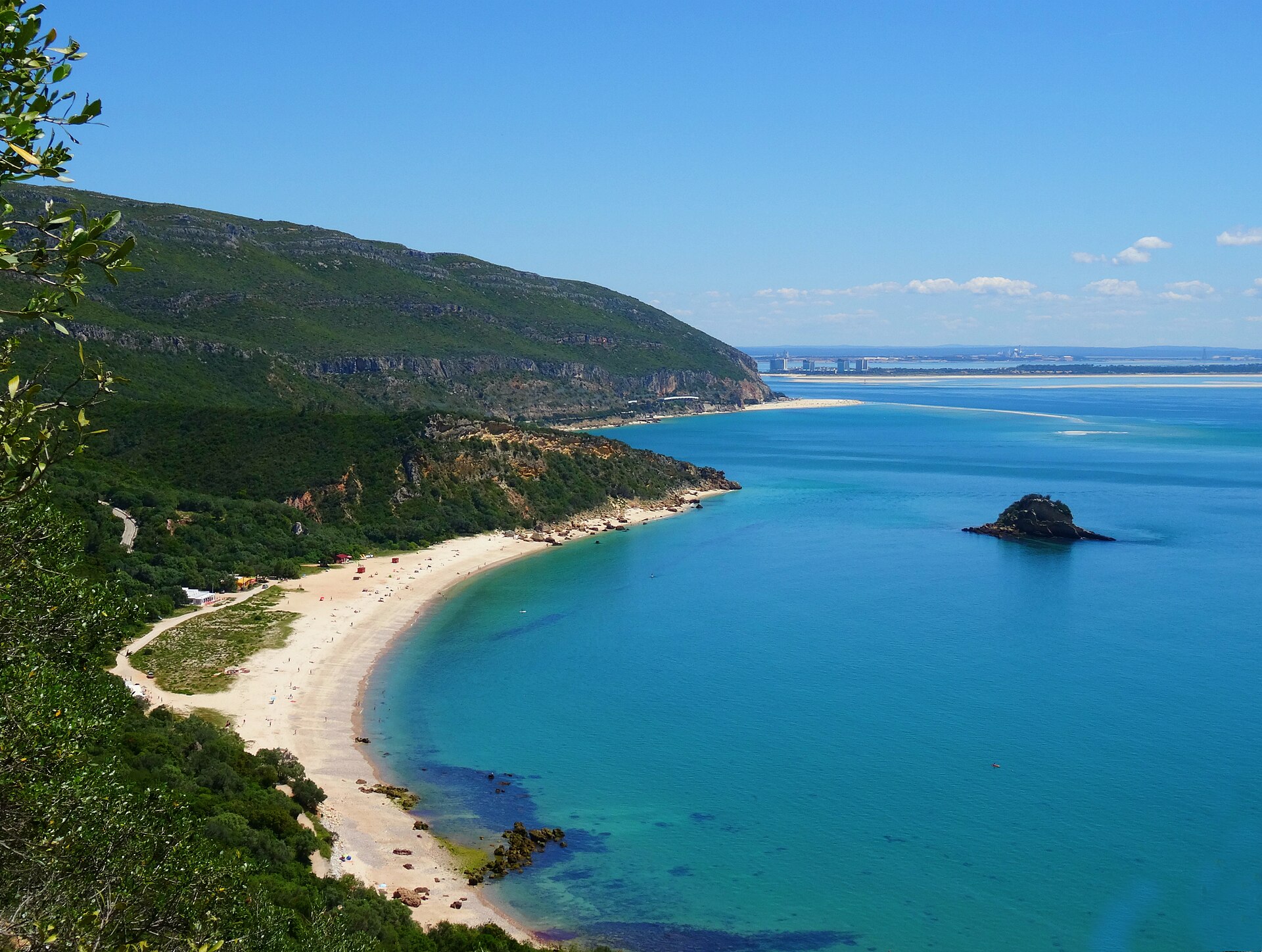
This is the single fact that catches people out, so it earns its own section. Setúbal runs a program called Arrábida sem Carros, now in its ninth edition, and for 2026 it is in force from 4 June to 15 September. During that window the access roads to Portinho da Arrábida, Creiro and Galapos are closed to private cars every day from 07:00 to 20:00, from the junction known as the cruzamento do Pinheiro, and they are shut completely the moment the small Creiro car park (about 140 spaces) fills up. The nearby Albarquel and Figueirinha approaches are restricted on the same hours, and for 2026 the Figueirinha car park is closed altogether after winter storms damaged the access road. The Rua Círio da Arrábida, between the Figueirinha tunnel and Galapos, has been permanently shut since February 2023 because of rockfall risk. Source: Câmara Municipal de Setúbal.
What this means in practice is simple. A rental car can leave you turning around at a barrier or sitting in a queue for a car park that is already full. Licensed taxis and licensed ride vehicles in active service are among those allowed through, so a private licensed tour reaches places a self-drive day cannot, or, when the beaches themselves are not the plan, spends the day on the Serra viewpoints, the Convento da Arrábida and Sesimbra instead. Either way, the point of going with someone local in summer is that they already know the calendar, the hours and the alternatives.
Portugal's only resident dolphins
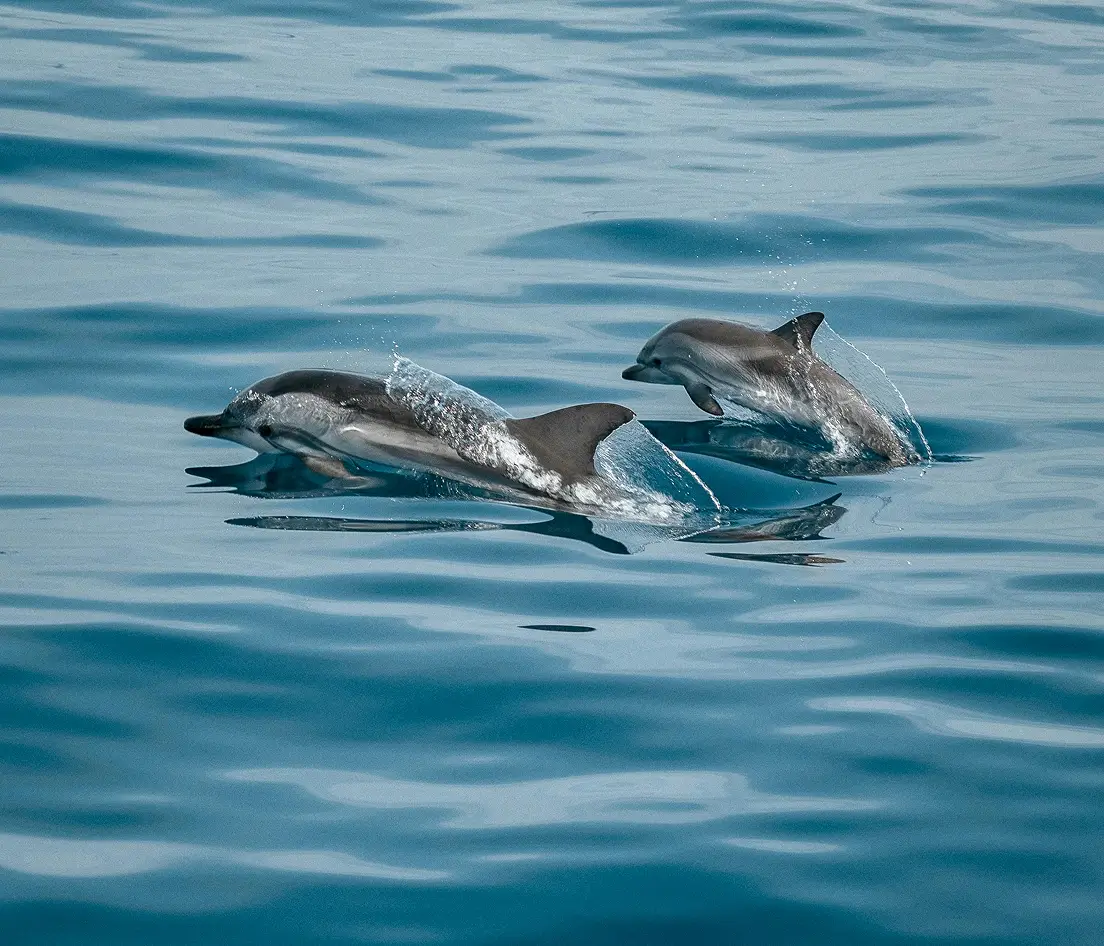
The Sado estuary is home to a small resident population of around 26 bottlenose dolphins (ICNF, after a calf was born in July 2025). That number matters: this is the only resident dolphin population in Portugal, and one of only three resident estuarine colonies in all of Europe, alongside ones in Scotland and Ireland. Some of the animals are over forty years old, and they are individually known from the marks on their dorsal fins. Seeing them is not the same as a generic boat trip with a 30 euro ticket. It is wildlife watching with real scarcity behind it.
Two honest things to know before you book. First, this is wild-animal watching, so it is never guaranteed; licensed operators report sightings on the large majority of trips, but the right word is probability, not promise. Second, ethics and timing are connected here. Sado boats need a licence from the ICNF, and a legal code of conduct applies: keep your distance, never chase or feed the animals, and do not crowd them, with no more than three boats within 100 metres. Some boats operate without a proper licence, so choosing a licensed operator is both the ethical choice and the one that respects the animals you came to see.
The seasonal catch is August. For three summers running, the ICNF has closed the mouth of the estuary to dolphin observation throughout the whole of August and paused all observation daily between 13:00 and 15:00, while keeping trips open along the Arrábida coast, the Tróia coast and the rest of the Sado. The same restriction is expected to return in August 2026. A good operator plans around it, which is one more reason a morning departure and a bit of local knowledge are worth more here than a cheap ticket.
The wine: Azeitão and a cellar from 1834
If you choose the wine day, the anchor is José Maria da Fonseca in Vila Nogueira de Azeitão. Founded in 1834, it is the oldest table-wine company in Portugal, still family-run and now in its seventh generation. This is the home of Moscatel de Setúbal, the region's sweet fortified Muscat, and of Periquita, the country's oldest red-wine brand. The visit runs through the old house, restored in 1923, and the cellars, including the Adega dos Teares Velhos where Moscatéis more than a century old still rest, before a tasting of the wines with regional products.
One practical note that genuinely matters: visits and tastings run at fixed times with limited capacity, so booking ahead is effectively required, especially at weekends and in high season. Tastings range from premium options starting near 5 euros per person up to special tastings. On a private tour this is arranged for you, along with the local sheep's cheese and the soft rolled sponge cakes called tortas de Azeitão. Drive yourself and you may arrive to find the next slot is in ninety minutes.
The beaches, honestly
The Arrábida beaches, Galapinhos, Portinho, Figueirinha, are some of the most beautiful in the country, with clear, calm water under the green ridge. They are also the part that disappoints visitors most, because in summer they are hard to reach and fill early, and the restrictions above are real. If lying on the sand is your main goal, the honest plan is a dedicated public-transport beach day in the off-peak shoulder, not a packed tour. If what you want is the scenery, the wine or the dolphins, the Serra viewpoints give you the views without the access stress, and that is what our days are built around.
Wine day or dolphin day
Here is the choice in one table.
| The choice | Wine & Heritage | Dolphin Watching |
|---|---|---|
| Centre of the day | Tasting at José Maria da Fonseca, the Serra ridge, Azeitão tiles and sweets | Licensed boat to the Sado's resident dolphins, Cristo Rei, Cabo Espichel, Sesimbra |
| Best for | Couples, wine and scenery, a slower pace | Families, wildlife and coast, a little more driving |
| Season note | Year-round; summer access rules shape the coast, not the cellar | Best spring to autumn; in August the boat works away from the estuary mouth |
| From, website price, 2 people | 388 euros | 428 euros |
If you still cannot decide and you have the time, larger groups can have both arranged across one long day as a tailor-made option, though for most people one focused day beats two rushed halves.
How long you need, and when to go
Azeitão is about 40 to 50 minutes from central Lisbon and the Serra viewpoints around an hour, crossing the 25 de Abril bridge, where the toll is charged northbound so you pay it on the way back in.
A full day is the honest unit here. Both versions of the peninsula, the wine day and the dolphin day, fill one comfortably, and neither compresses well into a half day once you have crossed the river.
Season decides which day makes sense. The wine and heritage day runs year-round, because the cellars and the Serra ridge do not care about the calendar. The dolphin day is best from spring to autumn, and in August the boat works away from the estuary mouth.
Summer changes the coast, not the cellars. From 4 June to 15 September 2026 the Arrábida sem Carros programme closes the access roads to Portinho da Arrábida, Creiro and Galapos to private cars every day from 07:00 to 20:00, and shuts them entirely once the Creiro car park, about 140 spaces, fills up. If beach time is the point of your day, that window decides how you get there.
Is it worth it if you only have one day?
Yes, and one day is arguably the right amount. The mistake is not the length, it is the ambition.
The peninsula sits close enough to Lisbon that people try to stack it: Cristo Rei, the market, a tile workshop, a tasting, the ridge, Sesimbra, a boat. Each of those is worth doing. Together, in one day, they become a series of car parks.
Pick the wine day or the dolphin day and let the other one go. If you genuinely want both, take them as two days. One focused day beats two rushed halves, and that holds here more than almost anywhere else near Lisbon.
Group or private
You can do parts of this on a big coach tour, and it will be cheaper. What you lose is exactly what makes the peninsula work: a vehicle that is allowed through the summer restrictions, a guide who books the winery slot and the licensed boat, and the freedom to swap the plan when a car park is full or the wind picks up. A private day here is not about luxury, it is about the day actually happening the way it was meant to.
What is nearby
If you have more days from Lisbon, the natural companions to this trip are Sintra for palaces and forest, Évora for the Alentejo and its Roman and megalithic heritage, and Lisbon itself for a slower city day. Each is a different kind of day out, and together they make a strong three or four day base.
Our honest recommendation
For a first visit with limited time, take the Wine & Heritage day if you love wine and scenery and want a calm pace, and the Dolphin Watching day if you are travelling with children or the wildlife is the dream. Go in the morning, book ahead, and treat the dolphins as a strong probability rather than a certainty. Then let someone who knows the summer rules handle the logistics, so your day is spent looking at the view instead of looking for parking.
Frequently asked questions
Can you drive to the Arrábida beaches in summer?
From 4 June to 15 September 2026, Setúbal's Arrábida sem Carros program closes the roads to Portinho da Arrábida, Creiro and Galapos to private cars, daily from 07:00 to 20:00, and shuts them entirely once the Creiro car park fills. Licensed taxis and ride vehicles in service may pass. Source: Câmara Municipal de Setúbal.
How many dolphins live in the Sado estuary?
The Sado estuary near Setúbal has a small resident population of around 26 bottlenose dolphins (ICNF, 2025 to 2026, after a calf was born in July 2025). It is the only resident dolphin population in Portugal and one of just three resident colonies in Europe, alongside Scotland and Ireland.
Can you see the Sado dolphins in August?
Yes, but not at the river mouth. For three summers running, the ICNF has closed the entrance of the estuary to dolphin boats throughout August and paused all observation daily from 13:00 to 15:00. Trips continue along the Arrábida and Tróia coasts. The same is expected in August 2026. Source: ICNF.
What wine is Setúbal known for?
The Setúbal Peninsula is the home of Moscatel de Setúbal, a sweet fortified Muscat. José Maria da Fonseca, founded in Azeitão in 1834, is Portugal's oldest table-wine company and the classic place to taste it, alongside its Periquita reds, the country's oldest red-wine brand, and Azeitão sheep's cheese.
Arrábida or Sintra: which day trip from Lisbon?
Sintra is palaces and crowds; Arrábida is nature, wine and coast with far fewer visitors. Choose Sintra for fairy-tale castles, Arrábida for clifftop Atlantic views, a historic Azeitão wine cellar, or wild dolphins on the Sado. Both sit about an hour from Lisbon.
Do you need to book the José Maria da Fonseca visit in advance?
Yes. Guided visits and tastings at José Maria da Fonseca in Azeitão run at fixed times with limited capacity, so booking ahead is essentially required, especially in high season. Tastings range from premium options near 5 euros per person up to special tastings. On a private tour, this is arranged for you.
When is the best time for dolphin watching on the Sado?
Because the dolphins are resident, watching runs from early spring to late autumn, and sometimes into winter when seas are calm. There is no migration to wait for. Morning departures, around 09:30, usually have the flattest water and the best light, which matters most in the busy summer months.
How far is Arrábida from Lisbon, and how do you get there?
Azeitão is about 40 to 50 minutes from central Lisbon and the Serra da Arrábida around an hour, crossing the 25 de Abril bridge. Public transport reaches Setúbal and Azeitão by train and bus, but reaching the Serra viewpoints and the Sado boat without a car is slow.
Is Sado dolphin watching ethical?
It can be, if you pick a licensed operator. Sado boats need an ICNF licence, and a legal code of conduct applies: keep distance, never chase or feed the animals, and limit time alongside, with no more than three boats within 100 metres. Some boats operate unlicensed, so the choice matters. Source: ICNF.
Wine day or dolphin day: which Setúbal tour should you choose?
Pick the Arrábida wine tour from Lisbon for a slower day of Moscatel, cheese and Serra viewpoints, ideal for couples. Pick the Sado dolphin watching day from Lisbon for wildlife, the Sado boat and the coast, which families tend to prefer. Wine & Heritage starts at 388 euros for two; Dolphin Watching at 428 euros, website price.
What should you eat in Setúbal and Azeitão?
Setúbal's signature dish is choco frito, fried cuttlefish served with chips and salad, best near the fishing harbour. Azeitão is known for its DOP sheep's cheese, soft and tangy, and for tortas de Azeitão, light rolled sponge cakes. Lunch is not included on the tour, so your guide books a good local table.
Are the Arrábida beaches worth visiting, or just the viewpoints?
The beaches, Galapinhos, Portinho and Figueirinha, are genuinely beautiful, with clear water under the Serra. But in summer they are hard to reach by car and fill early. If beach time is your priority, plan a public-transport day; if you want scenery and wine, the Serra viewpoints deliver without the access stress.
Last updated . Opening hours, prices and access rules are checked against official sources.
See Arrábida & Setúbal with ease.
Two private days from Lisbon, each at your own pace with hotel pickup and a driver-guide: the Serra ridge with the Azeitão cellars, or a licensed boat to the Sado's resident dolphins.
Arrábida wine tour from Lisbon Sado dolphin watching day from Lisbon