

Founder & CEO of Swingo
Évora sits about an hour and a half east of Lisbon and is not one sight but three ages inside one set of walls: a stone circle older than Stonehenge, a Roman temple from the age of Augustus, and a UNESCO medieval town. The catch is that the best of it sits outside the walls.
Most visitors come to Évora for the Chapel of Bones and leave talking about a field of stones in the middle of nowhere. That is the first thing to understand about this city. It is not one sight, it is three ages stacked inside one set of walls: a prehistoric stone circle older than Stonehenge, a Roman temple from the age of Augustus, and a medieval town of marble and cork, all inside a UNESCO World Heritage centre about an hour and a half east of Lisbon.
The catch is that the two things you are most likely to remember sit outside the walls, on roads that punish a rental car and reward someone who knows them. We have been running private tours to Évora from Lisbon for years, so this guide is written from the road, not from a brochure. Here is how to get there, what is genuinely worth your time, what the typical day trip gets wrong, and how to choose the version of Évora that fits you.
First, what Évora actually is
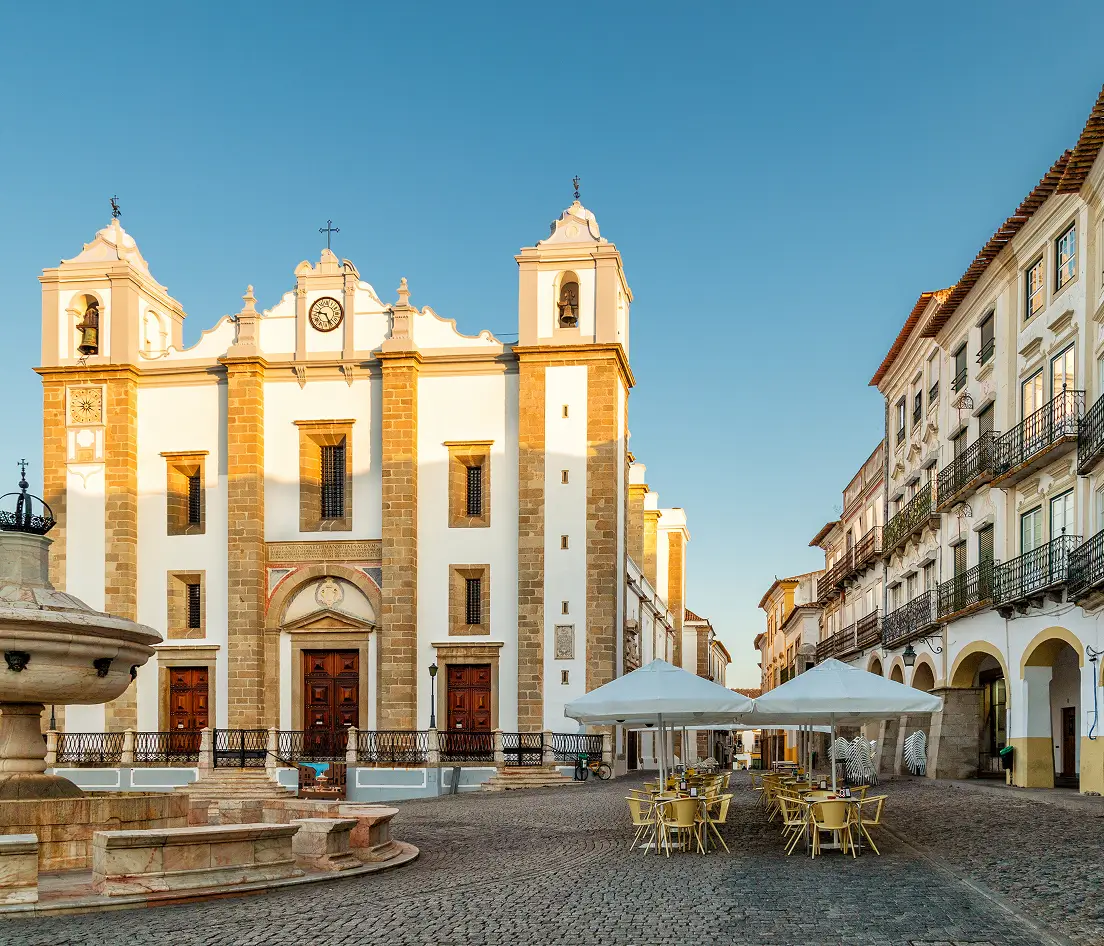
Évora has been a UNESCO World Heritage Site since 1986, and the reason is density. Inside a ring of medieval walls you can walk in twenty minutes, the city stacks Roman, Gothic, Renaissance and Baroque on top of each other, with Alentejo marble underfoot and whitewashed houses trimmed in ochre. It is small. You can see the core of it in a single day, which is exactly why so many people treat it as a quick stop and miss the point.
The point is the layering, and the two world-class sites just outside town: the Almendres Cromlech to the west, and the medieval village of Monsaraz over Lake Alqueva to the east. Get those right and Évora is one of the best days you can have out of Lisbon. Rush them and it is just another pretty old town.
How to get to Évora from Lisbon
Évora sits about 130 km east of Lisbon, roughly a 1 hour 20 to 1 hour 30 drive on the A2 and A6 motorways, tolls included. You will see it described as "just over an hour", and on an empty road it nearly is, but plan for 1h30 door to door and you will not be caught out.
There are trains and buses from Lisbon, and they are cheaper, but they are slower and less frequent, and they leave you with the same problem once you arrive. The walled city is easy on foot, but the Almendres Cromlech and Monsaraz are well outside it, and neither has any useful public transport. The drive is part of the day, long straight roads through cork oak and olive country, with stork nests on the pylons. On a private tour you are collected at your hotel and the timing is handled, which matters more here than it sounds, because the sights are spread out and the megaliths reward arriving at the right hour.
The walled city: what to see
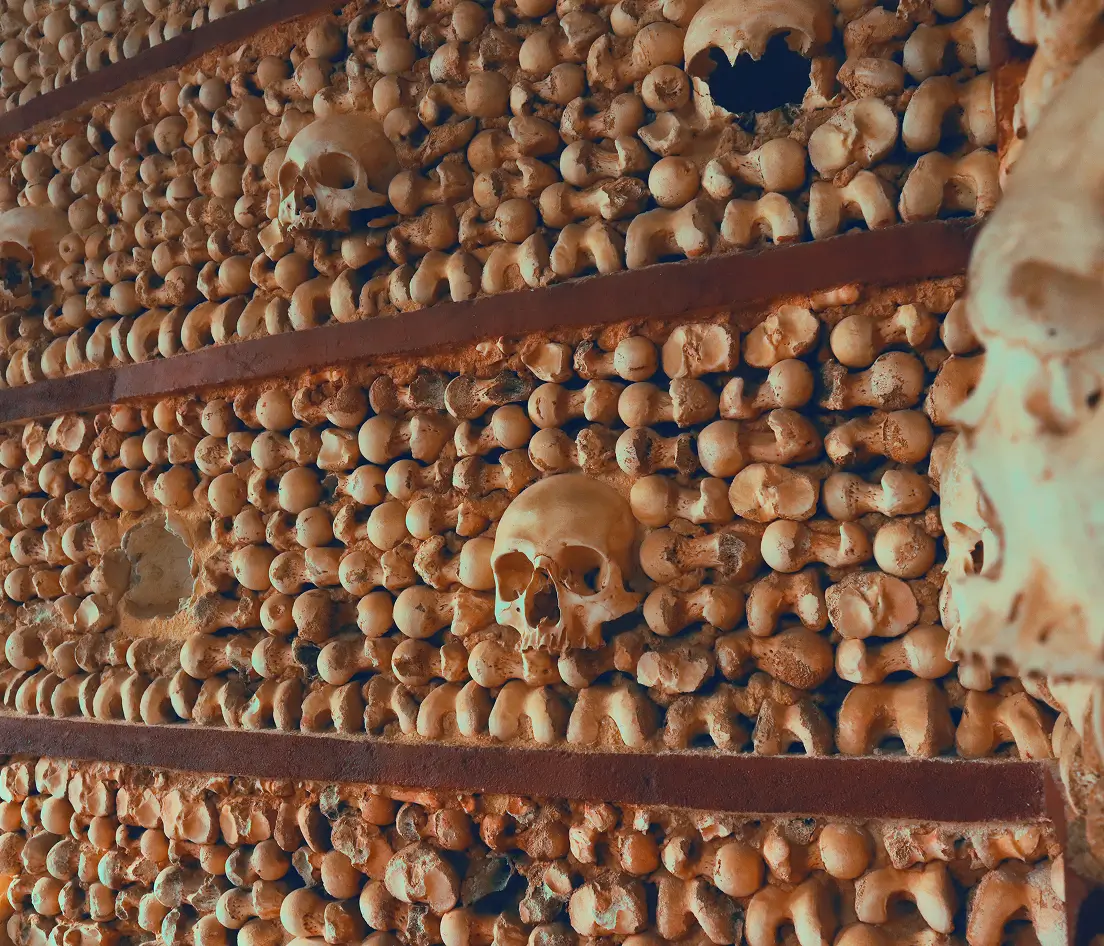
The famous stop is the Chapel of Bones, the Capela dos Ossos inside the Church of São Francisco, and it is not a horror prop. It was built in the 17th century by Franciscan friars as a memento mori, a deliberate confrontation with the shortness of life, its walls and eight pillars lined with around 5,000 skulls and bones gathered from the city's old cemeteries. The inscription over the door sets the tone: "we bones that are here await yours". The church itself is free to enter, and a single ticket to the chapel and its museum rooms is 7 euros for adults, 5 for under-25s and over-65s. Walk in knowing what it is and it lands harder than any scare.
The better story is the Roman Temple. You will see it sold everywhere as the "Temple of Diana", and it was never anything of the sort. There is no archaeological evidence of a cult of Diana here. The name comes from a 17th-century legend invented by a local priest, and the evidence points instead to the imperial cult of Augustus, in the forum of the Roman town. Built in the 1st century AD, it kept 14 of its 18 Corinthian columns standing partly because it spent centuries walled up as a castle tower and a butcher's hall. A guide who tells you it was never Diana's is a guide worth having. Around these two, give time to the Cathedral, the marble-paved Praça do Giraldo, and the quiet lanes in between.
The stones older than Stonehenge, and the road to get there
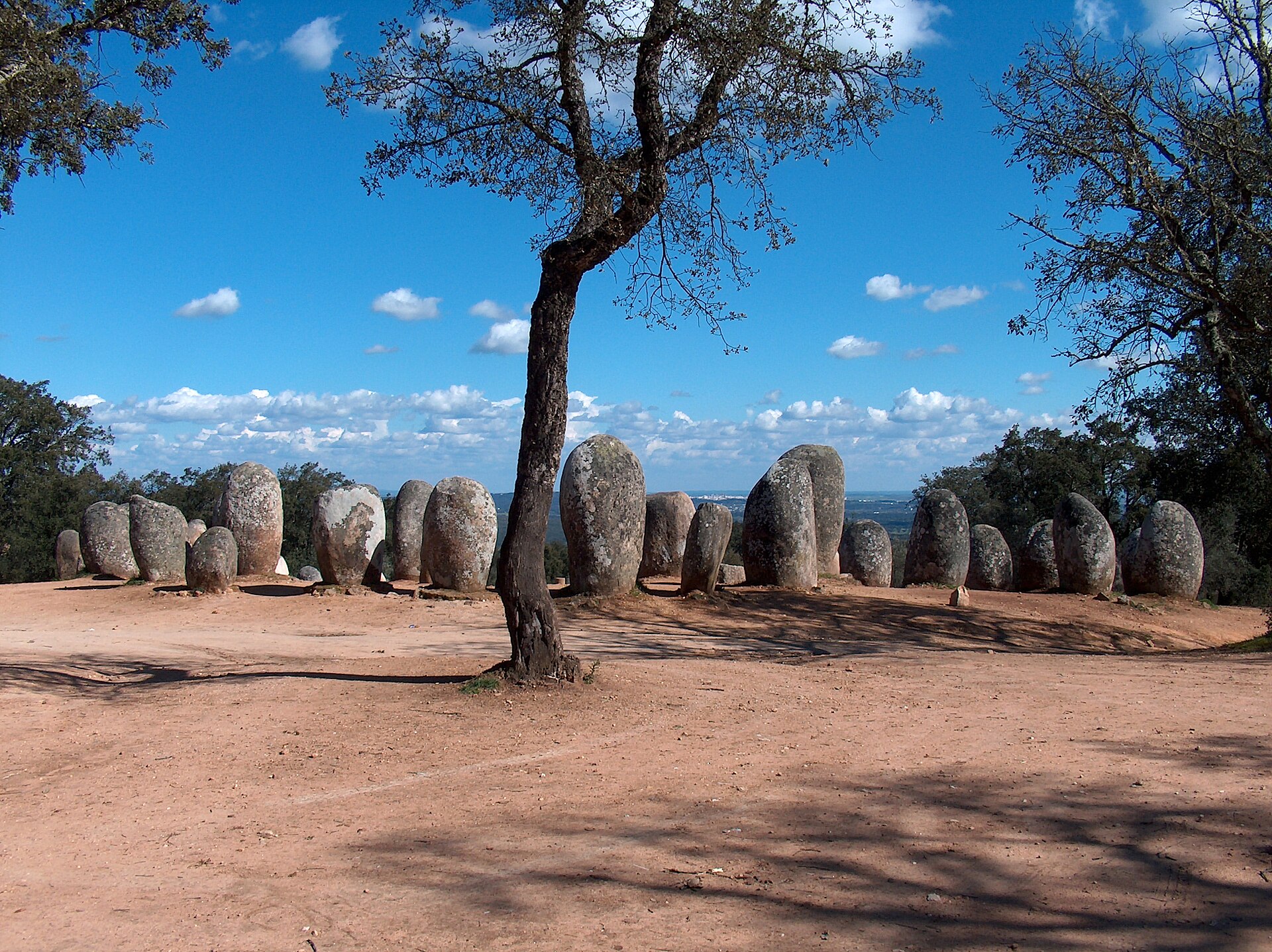
Thirteen kilometres west of the city, in a clearing of cork oaks, stands the Almendres Cromlech, the largest group of standing stones on the Iberian Peninsula and one of the oldest in Europe. Ninety-five stones were raised here in stages between roughly 6000 and 3000 BC, about 2,000 years before Stonehenge. It was lost to vegetation until 1964, when a geologist mapping the region found it, and it has been a National Monument since 2015.
Here is the part the brochures skip. The site closed for a year of conservation and reopened in September 2024, now with a marked circuit around the stones to stop visitors eroding the ground. Entry is free. But the last stretch of the approach is still an unpaved dirt track full of potholes, with no public transport and nowhere easy to turn, and a low rental car has a bad time on it. This is the clearest case in the whole region for travelling with a vehicle and a driver who knows the road, and a guide who can turn a confusing scatter of granite into the thing it actually is. Standing among stones that were already ancient when the pyramids went up, with the right person explaining them, is the moment most people remember from Évora.
Alentejo wine, and tasting at Cartuxa
The Alentejo around Évora is one of Portugal's great wine regions, known for full-bodied reds from grapes like Aragonez, Trincadeira and Alicante Bouschet. The classic place to taste them is Adega Cartuxa, just outside town at the Quinta de Valbom, run by the Eugénio de Almeida Foundation in a former Jesuit retreat. It is the home of Pêra-Manca, the near-mythical Alentejo wine, and the setting gives the tasting a sense of place a generic cellar door cannot. The standard guided visit and three-wine tasting runs about 90 minutes and costs 25 euros a head, by appointment only, usually paired with local olive oil and Évora sheep's cheese. This is the wine version of the day. If wine is not your thing, skip it without guilt, there is plenty of Évora left.
Monsaraz and Lake Alqueva
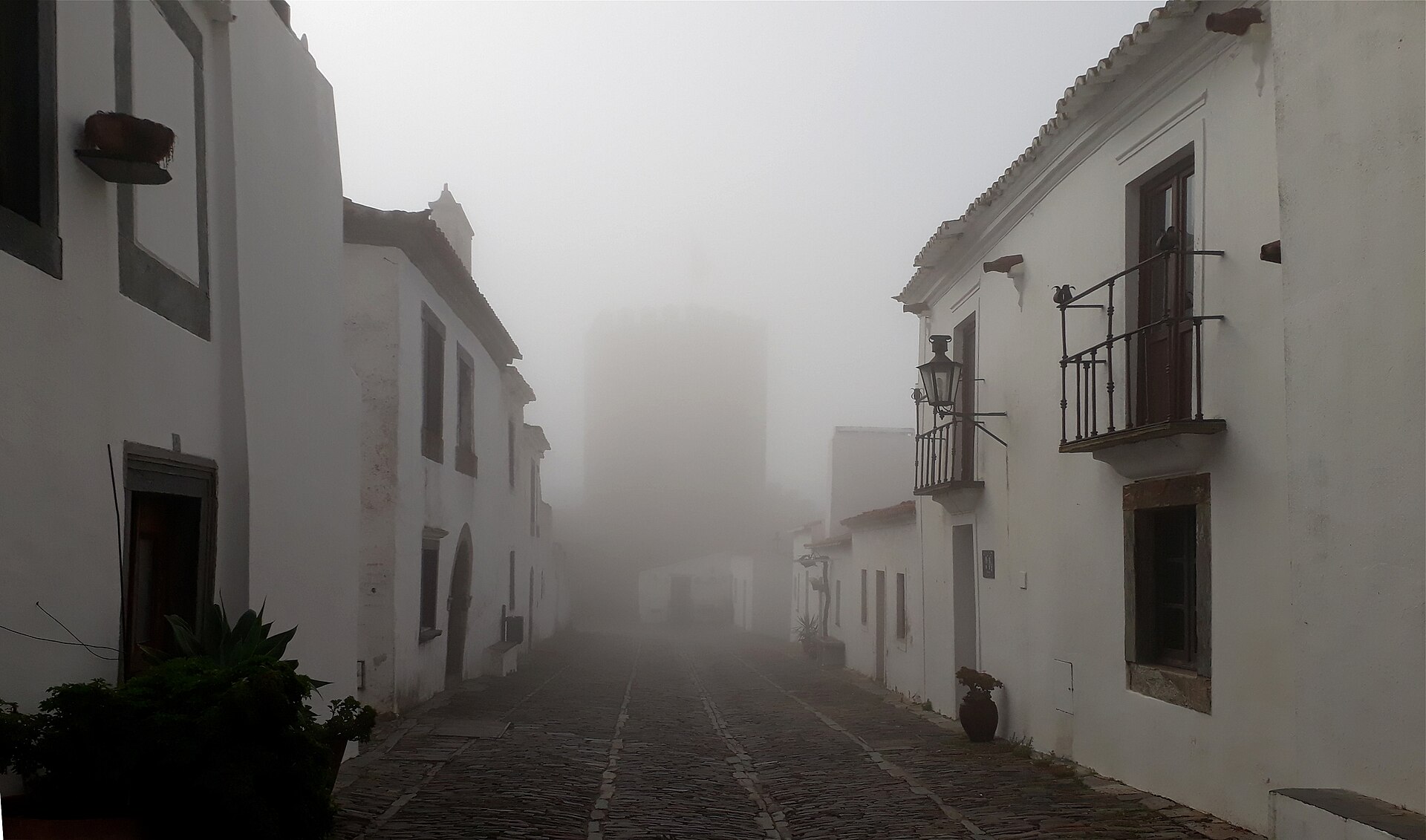
East of Évora, about an hour on, the land opens onto Lake Alqueva and the village of Monsaraz appears on its hill. Monsaraz is car-free, a tight grid of whitewashed, schist-paved lanes inside the walls of a 14th-century castle that is free to enter, once a Templar stronghold guarding the frontier with Spain. Below it spreads Alqueva, Europe's largest artificial lake at around 250 square kilometres, at the heart of the world's first certified Dark Sky reserve, which is why people come back here after dark to look up. It is the landscape version of the day, and the most photogenic corner of the region. One honest warning: it is a real hour beyond Évora, so bolting it onto the city, the megaliths and a wine tasting in one day is how you end up with twelve hours and no time to enjoy any of it.
How to plan your day, and the mistake almost everyone makes
The typical Évora tour tries to do everything at once: the city, the Almendres, Monsaraz, a winery and lunch, on a roughly twelve-hour march with more than two hours in the car each way, repeating the Diana myth along the way. It is exhausting and it does justice to none of it. The better approach is to choose your depth. We build the day three ways:
- Base: UNESCO city plus the Almendres stones. Best for first-timers who want the city and its prehistory. From 423 euros for 2 guests, direct.
- Cartuxa Wine: Base plus winery visit and tasting. Best for couples and wine lovers. From 521 euros for 2 guests, direct.
- Monsaraz: Base plus medieval village and lake. Best for landscape and fortified-village fans. From 473 euros for 2 guests, direct.
Every version always includes Chapel of Bones and Cathedral entries, hotel pickup, and a private driver-guide. Pick the one that matches why you came, and the day has room to breathe.
Is Évora worth it if you are not religious or into wine?
Yes, and easily. The prehistoric Almendres, the Roman temple and the walled UNESCO core stand entirely on their own, no faith or wine interest required. Skip the Cartuxa option, take the Monsaraz day for the landscape, and you have a day built around deep history and big country. If you have already seen a lot of European old towns, be honest with yourself: it is the megaliths and the layering, not the centre alone, that make Évora different.
Group tour or private?
A group coach tour is cheaper per person and runs to a fixed schedule, usually cramming several stops into one long day. A private tour costs more, but it is built around you: hotel pickup, your pace, a vehicle that copes with the Almendres track, and a guide who handles the timing and tells you the real stories, starting with the temple that was never Diana's. For the access alone, Évora is one of the destinations where private earns its keep. It is the difference between seeing the stones and understanding them.
What else you can see nearby
Évora pairs well with the rest of the south. If you are building a few days out of Lisbon, Setúbal and the Arrábida coast make a strong contrast of dolphins, beaches and wine, Sintra delivers the palaces and the forest, and Lisbon itself rewards a proper guided day before or after. Each exists as its own private tour from the city.
Our honest recommendation
If it is your first time and you want the essential Évora, take the Base day, the city and the megaliths, and let someone else handle the dirt road and the timing. If you love wine, add Cartuxa. If you want the big Alentejo landscape, add Monsaraz, and do not try to do both in the same day. However you visit, Évora rewards the people who slow down and choose, and frustrates the ones who try to see all of it at once. Book direct with us and the whole day is handled, from your hotel door and back.
Ready to go? See our private Évora tour from Lisbon.
Évora pairs well with the coast. The Setúbal and Arrábida wine and heritage day covers the same Alentejo edge an hour closer to Lisbon, with a cellar visit instead of the megaliths.
Frequently asked questions
How far is Évora from Lisbon, and how long does it take?
Évora sits about 130 km east of Lisbon, roughly a 1 hour 20 to 1 hour 30 drive on the A2 and A6 motorways, tolls included. Trains and buses run from Lisbon but are slower and less frequent. Most day trips, private or group, travel by road. Source: VisitPortugal.
Is the Almendres Cromlech older than Stonehenge?
Yes. The Almendres Cromlech near Évora was raised in stages between roughly 6000 and 3000 BC, about 2,000 years before Stonehenge. It holds 95 standing stones, the largest such group on the Iberian Peninsula, rediscovered in 1964 during geological survey work and classified a National Monument in 2015. Source: VisitPortugal and Câmara Municipal de Évora.
Can you visit the Almendres Cromlech now, and how do you reach it?
Yes. The site reopened in September 2024 after a year of conservation, with a new marked circuit around the perimeter to limit erosion. It lies about 13 km west of Évora, and the final stretch is an unpaved dirt track with no public transport. Entry is free. Source: Câmara Municipal de Évora.
How much is the Chapel of Bones in Évora, and is the church free?
Entry to the Church of São Francisco is free. A single ticket to the Chapel of Bones and its museum rooms costs 7 euros for adults and 5 euros for under-25s and over-65s. The chapel is lined with around 5,000 skulls and bones. Summer hours run 9:00 to 18:30. Source: igrejadesaofrancisco.pt.
Was the Roman Temple of Évora dedicated to Diana?
No. Despite the popular name, there is no archaeological evidence the Roman Temple of Évora was dedicated to Diana, a label invented by a 17th-century legend. Evidence points to the imperial cult of Augustus. Built in the 1st century AD, it keeps 14 of its 18 Corinthian columns. Source: VisitPortugal.
Évora or Monsaraz: which makes a better day trip from Lisbon?
Évora is a compact UNESCO city of Roman, medieval and prehistoric sights, about 1h30 from Lisbon. Monsaraz is a smaller medieval village over Lake Alqueva, roughly an hour beyond Évora. Many visitors combine both in one full day. A private tour lets you pick city-only or city plus Monsaraz without rushing twelve hours.
Do you need a car to see Évora and the Alentejo megaliths?
Évora's walled centre is easily walked. The megaliths are the problem: the Almendres Cromlech is 13 km out on a dirt track, and Monsaraz is about 50 km away, both with little useful public transport. Rental cars struggle on the Almendres approach. A private driver-guide removes that friction. Source: Câmara Municipal de Évora.
What wine is the Alentejo known for, and can you taste at Cartuxa?
The Alentejo around Évora is known for full-bodied reds from Aragonez, Trincadeira and Alicante Bouschet. Adega Cartuxa, run by the Eugénio de Almeida Foundation at the historic Quinta de Valbom, is a classic place to taste. Its standard visit and three-wine tasting is 25 euros, by appointment, about 90 minutes. Source: Cartuxa.
How long do you need in Évora, and when should you go?
A full day covers the walled city comfortably; add Cartuxa or Monsaraz and you fill the day. Spring and autumn are the most pleasant. Alentejo summers are punishing, often above 35°C at midday, so an early start matters. Winter is quiet and cool, and the monuments shorten their hours. Source: VisitPortugal.
Is Monsaraz worth it, and is the castle free?
Monsaraz is a car-free medieval hilltop village and former Templar stronghold, with a 14th-century castle that is free to enter. It overlooks Lake Alqueva, Europe's largest artificial lake at around 250 km², inside the world's first certified Dark Sky reserve. The cobbled lanes limit wheelchair and stroller access. Source: VisitPortugal and Visit Évora.
How much does a private Évora tour from Lisbon cost?
Swingo's private Évora day tour starts at 423 euros for two on the website Direct rate, covering the UNESCO city and the Almendres megaliths. Adding the Cartuxa wine visit starts at 521 euros, and adding Monsaraz at 473 euros. Chapel of Bones and Cathedral entries are included, with hotel pickup. Source: Swingo.
Is Évora worth visiting if you are not into churches or wine?
Yes. The prehistoric Almendres, the Roman temple and the walled UNESCO centre stand on their own, with no faith or wine interest required. Skip the Cartuxa option and choose the Monsaraz day for landscape instead. If you have seen many European old towns, the megaliths are the real reason to come. Source: Swingo.
Last updated . Opening hours, prices and access rules are checked against official sources.
See Évora with ease.
A day trip to the Alentejo at your own pace, with hotel pickup and a private driver-guide, the Roman temple, the Bone Chapel and local wine.
Discover the Évora private tour