
Founder & CEO of Swingo
For one or two travellers with light luggage, take the Alfa Pendular: about 2 h 50 to Porto Campanhã, 35.70 euros in second class at the full 2026 fare (CP). For families or heavy luggage, a private transfer takes about 3 h 15 door to door. To see places on the way, add one to three stops.
Lisbon to Porto is about 310 km: three hours on the A1 motorway, or just under three on the fast train. Most travellers spend it as a lost day. A taxi to the station, suitcases lifted onto the train, another taxi at Campanhã, and the afternoon has gone. Yet the road between the two cities passes a walled medieval village, the beach of the largest wave ever surfed, a Gothic monastery that took more than a century to build, the Sanctuary of Fátima, and a baroque library where bats still patrol the shelves at night. So the useful question is how many of those to stop at, and for how long.
In September 2026, while we were designing our own Lisbon to Porto transfer, we read the reviews of the ones already on sale. The complaint that kept coming back was the clock. The best sellers offer up to four stops, most of them about an hour long. "Would recommend picking 3 instead, as Fátima is a bit of a drive and you only have a short amount of time there," wrote one traveller. On the Rick Steves travel forum, the advice that keeps coming up is two stops, three at most. This guide starts from that lesson. It compares the train, the bus, the car and a private transfer honestly, then goes through the six stops worth the detour, how to pair them, and what each option costs in 2026.
The four ways to get from Lisbon to Porto
All four work; which one is right depends mostly on your group and your luggage.
Train: the fastest, if you travel light
CP's Alfa Pendular runs from Lisbon Santa Apolónia to Porto Campanhã in about 2 h 50 (a few minutes less from Oriente), and the Intercidades takes about 3 h 15. There are 15 to 18 direct trains a day. In 2026 a second-class seat costs 35.70 euros on the Alfa Pendular and 28.05 euros on the Intercidades at the full fare, and CP's Promo fares are up to 65% cheaper if you book at least eight days ahead. For one or two people with a case each, going city to city, nothing beats it on time or price. What the train leaves out are the two ends of the journey: a taxi to the station in Lisbon, and in Porto either the five-minute connecting train from Campanhã to São Bento or another taxi to your hotel. You can break the journey in Coimbra or Aveiro, both on the line, but then you carry or store your luggage and buy two tickets.
Bus: the cheapest
FlixBus runs dozens of buses a day from Lisbon to Porto, taking 2 h 30 to 3 h 30, with fares from about 5 euros when you book early, and Rede Expressos covers the same route. It is the cheapest way north by a distance, with the train's limits: terminals at both ends, luggage in the hold, and no stops.
Rental car: freedom, with fine print
Driving yourself gives you the stops and the freedom to change the plan on the day. Budget for the A1 tolls, 25.05 euros for a car in 2026, plus fuel, parking and the one-way fee most rental companies charge for leaving the car in another city, so check that fee before you compare. The stops are where self-drive gets harder. Visitors park outside the walls in Óbidos and below the old university in Coimbra, the car parks near the sights fill by late morning in summer, and one of you spends the day watching the road. If you like driving abroad, it is a good way to do this trip. If you do not, a motorway plus three unfamiliar town centres is a long day at the wheel.
Private transfer: door to door, direct or with stops
A private transfer collects you at your Lisbon hotel, Lisbon Airport or the cruise terminal, and leaves you at your door in Porto, Vila Nova de Gaia or Porto Airport, with the luggage handled. Our Lisbon to Porto private transfer starts at 482 euros per vehicle for one to three travellers on the direct option, about 3 h 15, with tolls, fuel and parking included and a 1.25% booking fee at checkout. The same car can turn the journey into a day out: one, two or three stops on the way, with a driver-guide who walks with you while the bags stay locked in the vehicle.
| Option | Time, door to door | Price for 2 | Price for 4 | Luggage | Sightseeing on the way | Best for |
|---|---|---|---|---|---|---|
| Train (Alfa Pendular) | about 4 h with taxis at both ends | €71.40 at the full fare, plus taxis | €142.80 at the full fare, plus taxis | You carry it | None, unless you break the trip in Coimbra or Aveiro | One or two travellers, light bags |
| Bus | 3 h 30 to 4 h 30 with taxis | from about €10, plus taxis | from about €20, plus taxis | In the hold | None | The tightest budget |
| Rental car | 3 h 15 driving, plus your stops | €25.05 in tolls, plus rental, one-way fee, fuel and parking | The same, in a bigger car | In the boot | As many as you like; you drive and park | Confident drivers |
| Private transfer, direct | about 3 h 15 | €482 per car | €635 per van | Handled for you | None | Families, heavy luggage, arrivals at the airport |
| Private transfer, 2 stops | about 8 h | €666 per car | €806 per van | Locked in the car | Two places, two hours each, guide on foot | Seeing the country on a travel day |
What to see between Lisbon and Porto: six stops worth the detour
Six places sit close enough to the A1 motorway and the A8 coast road to work on a one-way day. They are very different from each other, which is why the pairing matters as much as the list. The detours below are the extra distance and driving time compared with the direct A1.
Óbidos, the walled village
Detour: about 7 km and 15 minutes, by the A8. Entry: free.
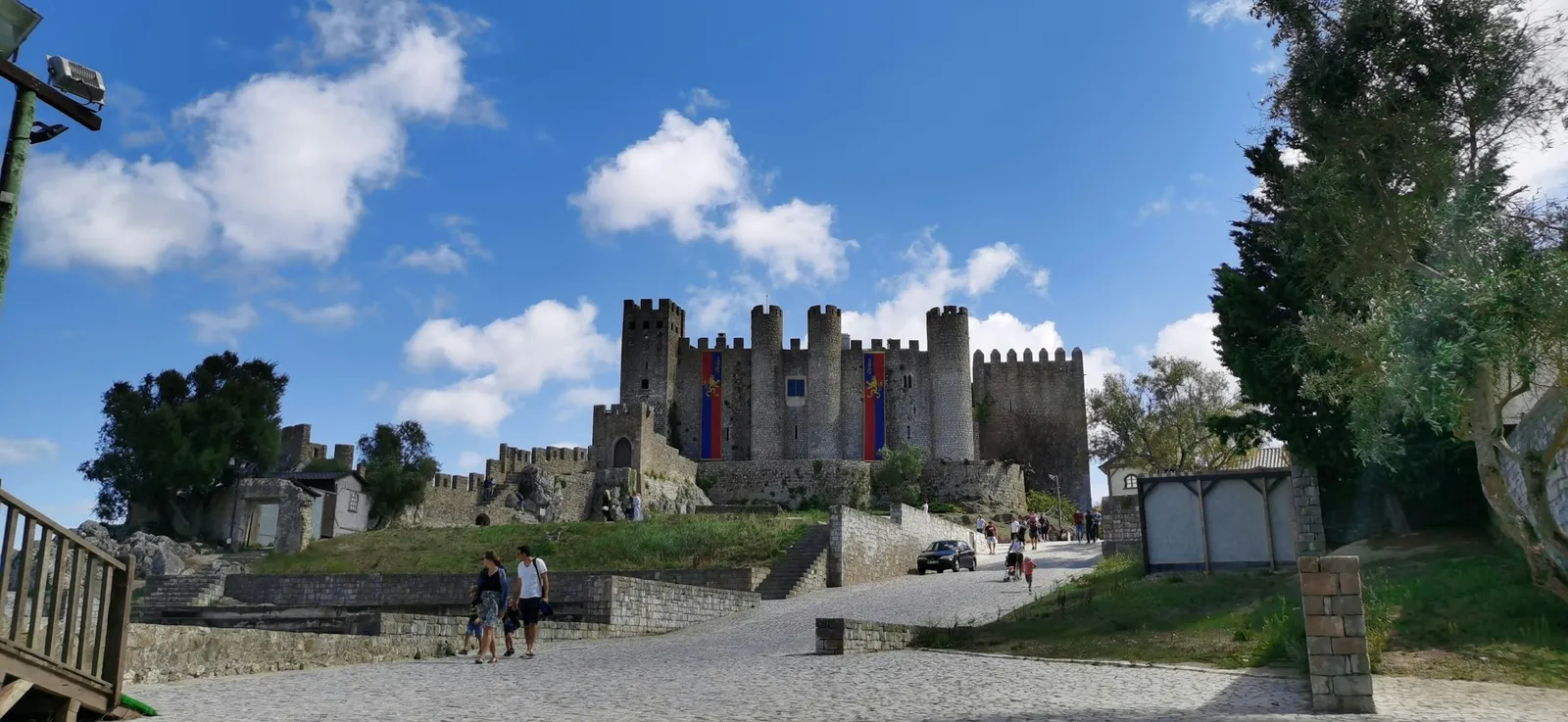
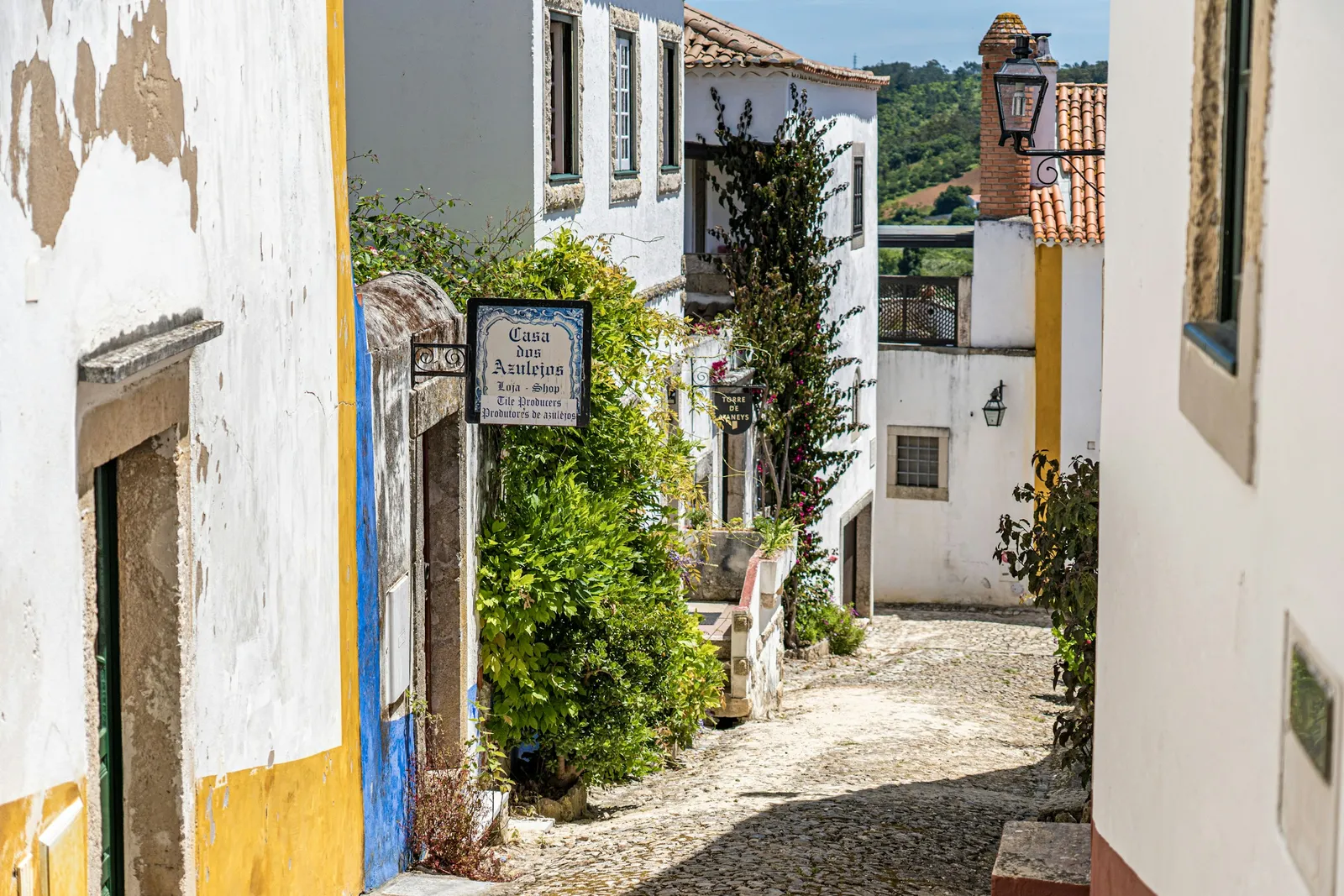
King Dinis gave Óbidos to Queen Isabel as a wedding present in 1282, and the town stayed in the hands of Portuguese queens for centuries. You can walk the full circuit of the walls without a ticket (the inner edge has no railing, so keep children close), follow the Rua Direita through whitewashed lanes, and drink ginjinha, the local sour cherry liqueur, from a chocolate cup for about two euros. Two hours covers it without rushing. Arrive early: by late morning in summer the main street is shoulder to shoulder.
Nazaré, the cliff and the big waves
Detour: about 26 km and 30 minutes. Funicular: 2.50 euros one way, 4 euros return. Fort: a small entry fee.
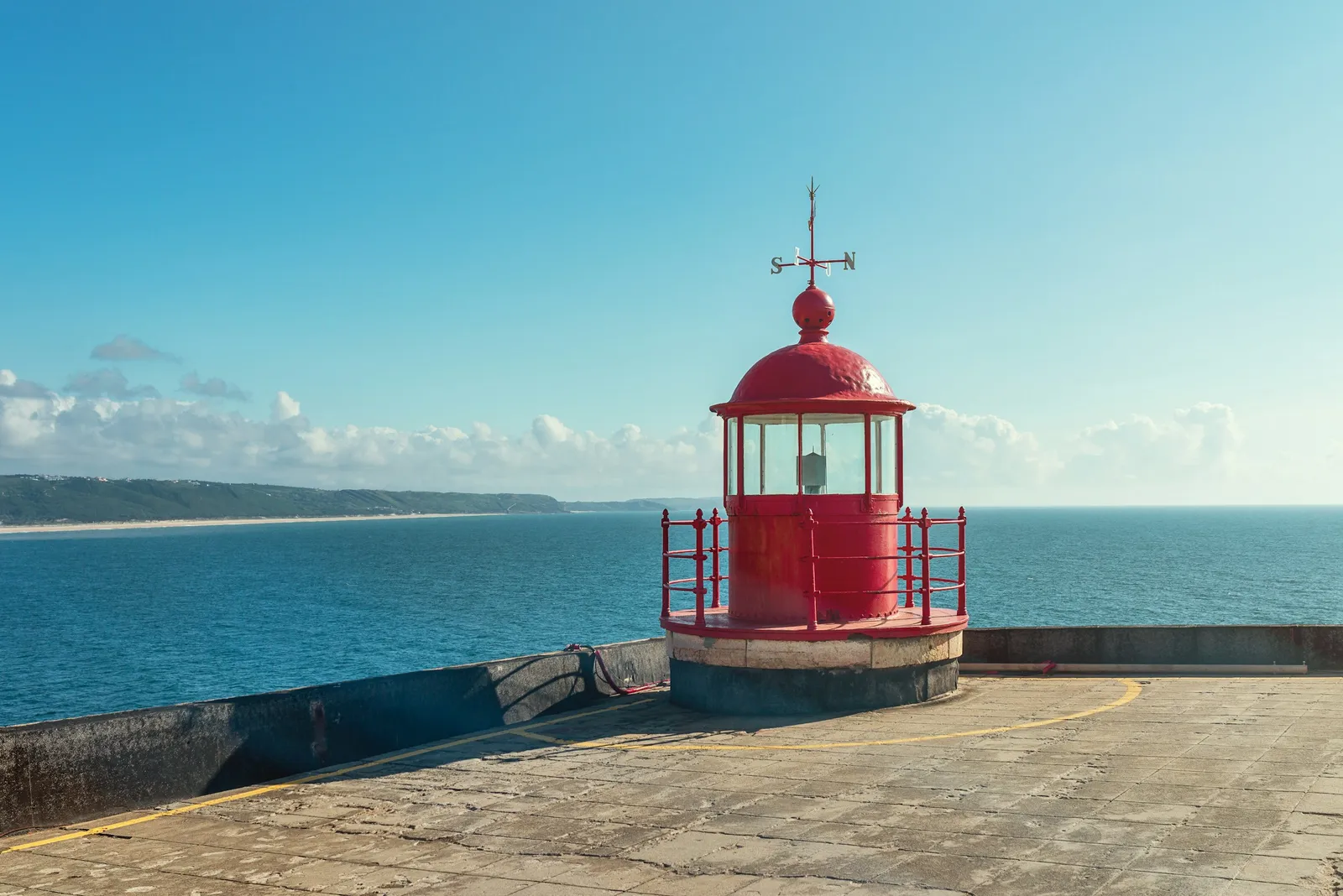
Nazaré is two places: the fishing town on the beach, and the Sítio on the cliff above it, joined by a funicular that has climbed the cliff since 1889. From the Sítio a path leads to the São Miguel Arcanjo fort and its red lighthouse, high above Praia do Norte. In October 2020 the German surfer Sebastian Steudtner rode a 26.21-metre wave here, certified by Guinness World Records as the largest wave ever surfed. The giant swells come between October and March, and only on some days, which the surf forecasts confirm just a few days ahead. In summer you get a busy beach town with a spectacular clifftop, still worth the stop.
Batalha, the monastery
Detour: about 5 km and under 30 minutes. Ticket: 15 euros (7.50 from 13 to 24 and over 65, free under 12). Parking: free.
The Monastery of Santa Maria da Vitória was begun in 1386 to give thanks for the victory at Aljubarrota, and the work went on for more than a century. It is a UNESCO World Heritage Site and one of the great Gothic buildings in Europe. The ticketed visit starts in the church and continues through the Royal Cloister, the Chapter House with the tomb of the Unknown Soldier, and the roofless Unfinished Chapels. It opens daily at 9:00 and closes at 18:30 from April to mid October and at 18:00 in winter, with last entry half an hour earlier; it is shut on 1 January, Easter Sunday, 1 May and 25 December. An hour covers the essentials; two hours let you see it properly and eat in the village.
Fátima, the sanctuary
Detour: about 6 km and 12 minutes. Entry: free.
The Sanctuary of Fátima stands where three shepherd children said the Virgin Mary appeared to them in 1917. It is free to enter, and the day's programme of prayer runs from early morning to the candlelight procession at 21:30. The heart of it is the small Chapel of the Apparitions; the Basilica of Our Lady of the Rosary holds the children's tombs, and the vast modern Basilica of the Holy Trinity faces it across the esplanade. Mass is said in the chapel at 12:30, every day in winter and Monday to Saturday from Easter to October, which suits a midday stop; in the summer season there is also a Mass in English at 15:30 on weekdays. On 12 and 13 May and 12 and 13 October the international pilgrimages draw very large crowds, so avoid those days unless the pilgrimage is why you are going. Our guide to visiting Fátima covers the Masses and the candlelight procession in detail.
Coimbra, the university
Detour: about 14 km and 18 minutes, plus 15 to 20 minutes to climb to the old town and park. Ticket: 16.50 euros with the Joanina Library.
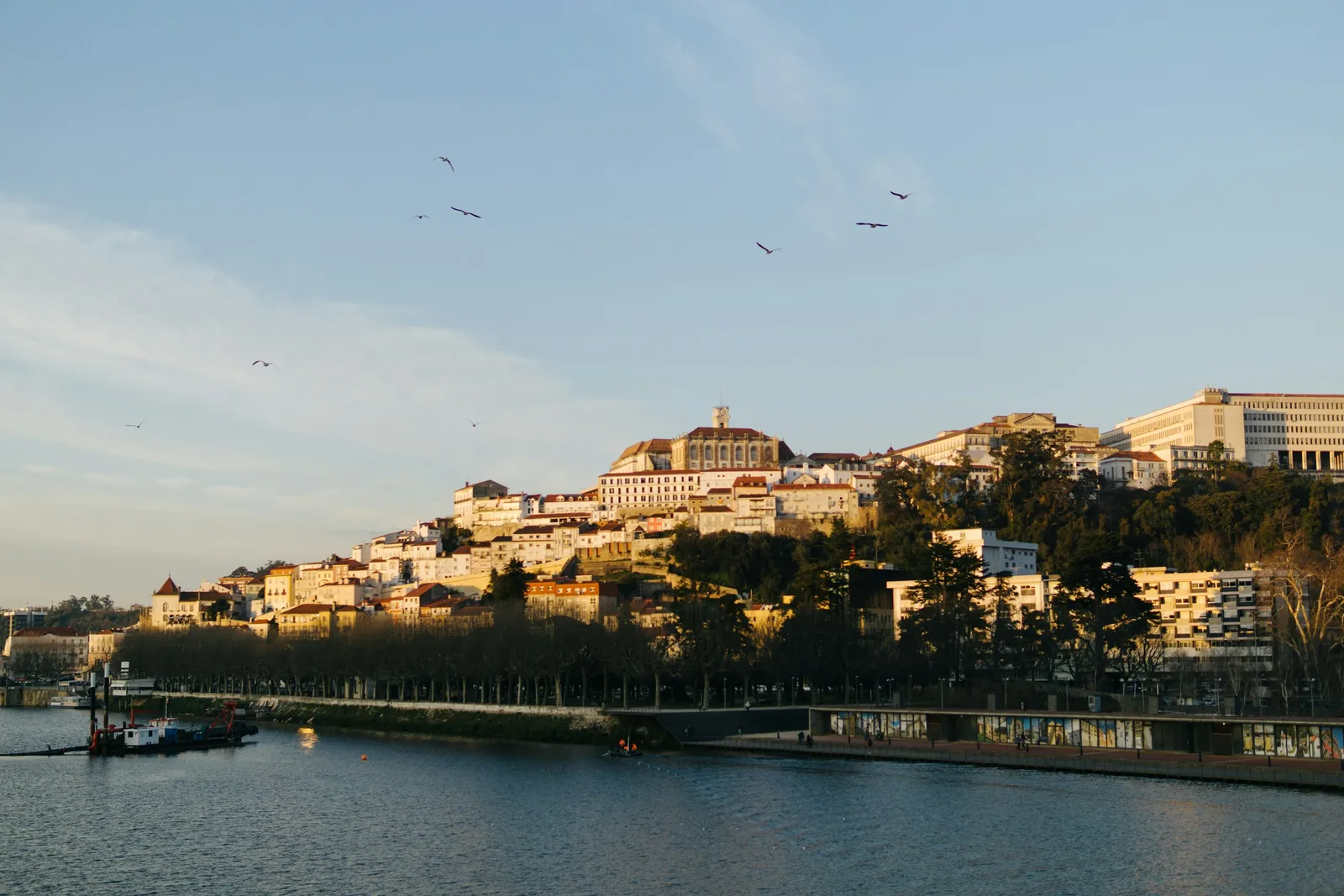
Coimbra is the stop that needs a plan. The old university at the top of the hill, a UNESCO World Heritage Site since 2013, holds the baroque Joanina Library, where a small colony of bats is left to eat the insects that would otherwise damage the books. Entry to the library is by timed ticket, limited to 50 people every 20 minutes, inside a university visit that costs 16.50 euros in 2026 (12.50 without the library), so the slot you book sets the timing of the whole stop. Once you add the climb and the parking, a one-hour stop does not work. Give Coimbra two hours and a booked slot, or leave it for another trip. Our Coimbra guide has the full picture.
Aveiro and Costa Nova, canals and striped houses
Detour: about 15 km and 22 minutes for Aveiro, 34 km and 40 minutes with Costa Nova. Boat trip: about 13 to 14 euros.
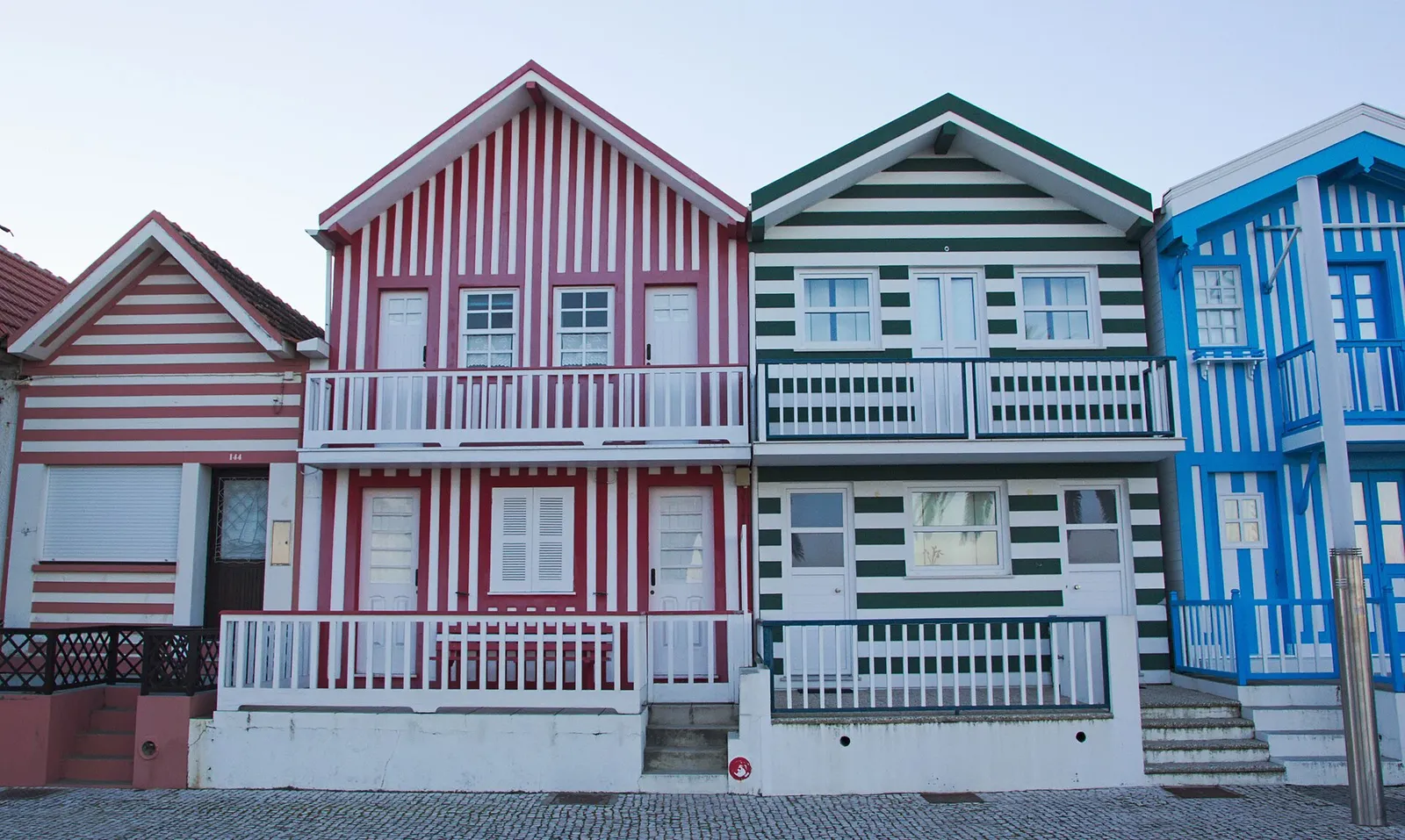
Aveiro is sold as the Venice of Portugal, and visitors who take that literally go home disappointed. Treat it as a pleasant canal town instead: a 45-minute ride on a painted moliceiro boat, ovos moles (the egg-yolk sweets with protected status), and some fine Art Nouveau facades. The better photograph is 11 km away at Costa Nova, where the old fishermen's huts are painted in candy stripes. Together they fill a two-hour stop, and they make the natural last stop before Porto, about an hour further north.
How many stops? Two, of two hours each
Four one-hour stops look generous on a booking page and feel rushed on the day: most of the time goes on parking, walking fast and climbing back into the car. We cap our own route at three stops by design. Two stops of two hours each is the balance we would choose for most travellers: about eight hours door to door, a proper look at each place, lunch at the second stop, and Porto by about five in the afternoon. Three stops make a full day of nine to nine and a half hours, at 1 h 30 each. When Coimbra is one of the three, we give it two hours and the other two an hour each, so the library still fits.
| Pairing | Why it works | Door to door |
|---|---|---|
| Óbidos and Nazaré | Medieval village and ocean cliff, both on the A8 coast road. The most requested pair. | about 8 h |
| Batalha and Nazaré | Gothic monastery and the big-wave beach, close to each other. | about 8 h |
| Fátima and Coimbra | Sanctuary and university, both just off the A1. | about 8 h |
| Óbidos, Nazaré and Batalha | The Silver Coast on a travel day, 1 h 30 at each. | about 9 h 30 |
| Nazaré, Fátima and Coimbra | Ocean, faith and the university. Coimbra gets two hours, the others one. | about 9 h 30 |
One pairing we steer people away from is Batalha with Fátima. They are only about 20 km apart, so the day spends both stops in the same corner of the map. Batalha sits better with Óbidos or Nazaré, and Fátima with Coimbra.
How long it takes, and when to go
Count about 3 h 15 door to door for the direct drive. With one two-hour stop it is about 5 h 45, so a 9:00 pickup reaches Porto around 15:00. Two stops take about eight hours (8:30 pickup, Porto around 17:00), and three take nine to nine and a half (arrival around 18:00).
Spring and autumn suit this road best. In summer, start early, because Óbidos and Nazaré fill up from late morning. In winter the limit is daylight: in December the sun sets a little after five, so a three-stop day ends in the dark and two stops are the better plan. Nazaré's big-wave season runs from October to March. Fátima is at its busiest on 12 and 13 May and 12 and 13 October.
Porto to Lisbon: the same road in reverse
Everything above works southbound, at the same price. The stops simply run backwards: Aveiro and Costa Nova in the morning, Coimbra or Fátima at midday, then Batalha, Nazaré or Óbidos in the afternoon, and Lisbon by the evening. Our Porto to Lisbon transfer with stops follows that order. One thing to watch: if you fly home from Lisbon the same day, take the direct option or a single stop, and leave the margin your airline asks for at the airport, usually two to three hours for an international flight.
Is it worth it, or should you just take the train?
For two people with a case each who simply want to be in Porto, take the train. It is faster than any car and costs a fraction of a private transfer. Even for a family of four, the direct transfer in a van (635 euros) costs more than four times the full Alfa Pendular fares (142.80 euros), before the taxis. What you pay for is the door-to-door part and, with stops, a day of sightseeing.
So a transfer makes sense in three situations. You are carrying real luggage, or travelling with children or older relatives who should not be hauling bags through two stations. You land at Lisbon Airport after a long flight and want to be driven straight to Porto. Or you were going to spend a separate day on an Óbidos and Nazaré day trip from Lisbon anyway; our Silver Coast day trip starts at 353 euros per group, and two stops on the way to Porto give you that day back.
If you are staying in Lisbon, or arriving in Porto
Not moving on? The same places work as day trips from Lisbon: Óbidos, Nazaré and Batalha on our Silver Coast day trip, Fátima on its own or with Batalha, and Coimbra with a booked Joanina slot. If you want to see Porto without changing hotels, the Porto from Lisbon day trip is a twelve-hour round trip, and we have written honestly about whether a Porto day trip is worth it. Once you are in Porto, the Porto Signature day covers the city, the port lodges and the food, and our Porto airport transfers take care of the flight home.
Our honest recommendation
A couple with light bags who only want to reach Porto should book the Alfa Pendular. A family with real luggage, or anyone arriving straight from the airport, will be glad of a direct private transfer, as long as they know it is a comfort and not a saving. And if you have the day, make a day of it: two stops, two hours each, Óbidos and Nazaré or Fátima and Coimbra, with someone who walks with you and takes care of the timing and the tickets. That is the Lisbon to Porto transfer with stops we run, and it works the same way from Porto to Lisbon.
Common questions about Lisbon to Porto
What is the best way to get from Lisbon to Porto?
For one or two travellers with light luggage, take the Alfa Pendular: about 2 h 50 to Porto Campanhã, 35.70 euros in second class at the full 2026 fare (CP). For families or heavy luggage, a private transfer takes about 3 h 15 door to door. To see places on the way, add one to three stops.
How long does the train from Lisbon to Porto take, and how much is it?
The Alfa Pendular takes about 2 h 50 from Lisbon Santa Apolónia to Porto Campanhã, a little less from Oriente, and the Intercidades about 3 h 15. Full 2026 second-class fares are 35.70 and 28.05 euros, and Promo fares bought at least eight days ahead are up to 65% cheaper. Source: CP.
How long is the drive from Lisbon to Porto, and how much are the tolls?
About 312 km on the A1, three hours to 3 h 15 without stops. In 2026 the A1 tolls from Lisbon to Porto cost 25.05 euros for a car. Each of the six stops adds a detour of 5 to 34 km, and the coast road via Óbidos and Nazaré uses the A8 instead. Source: Brisa toll tables, 2026.
What is worth seeing between Lisbon and Porto?
Six stops sit close to the route: Óbidos, a walled medieval village; Nazaré, the clifftop above the beach of the largest wave ever surfed; the Gothic Monastery of Batalha; the Sanctuary of Fátima; Coimbra's old university and Joanina Library; and Aveiro's canals with the striped houses of Costa Nova. Each needs one to two hours.
How many stops can you make between Lisbon and Porto in one day?
Two is the comfortable number and three the maximum. Two stops of two hours make an eight-hour day door to door; three stops of 1 h 30 make nine to nine and a half hours. Itineraries with four one-hour stops are the ones travellers describe as rushed in their reviews. In winter, short daylight favours two stops.
Is Coimbra worth a stop on the way to Porto?
Yes, with two hours and a booked slot. The Joanina Library admits 50 people every 20 minutes on timed tickets, inside a university visit that costs 16.50 euros in 2026. The climb to the old town and the parking take time, so a one-hour stop without a ticket is rarely worth it. Source: University of Coimbra.
Óbidos or Nazaré: which is the better stop?
Choose Óbidos for medieval architecture, with walls you can walk for free and ginjinha in a chocolate cup. Choose Nazaré for the ocean: the clifftop Sítio, the lighthouse fort above Praia do Norte and, from October to March, the chance of giant waves. They are only about half an hour apart on the A8, so many travellers take both.
Can you stop in Fátima on the way from Lisbon to Porto?
Yes. The Sanctuary sits about 6 km off the A1, adds roughly 12 minutes of driving and is free to enter. Mass is said in the Chapel of the Apparitions at 12:30, daily in winter and Monday to Saturday from Easter to October. The pilgrimages of 12 and 13 May and October bring large crowds. Source: Sanctuary of Fátima.
Is Aveiro worth a stop on the way to Porto?
Yes, if you treat it as a canal town rather than a little Venice. A 45-minute moliceiro boat ride costs about 13 to 14 euros, the ovos moles sweets are a protected local speciality, and the striped houses of Costa Nova are about 11 km away. Together they fill a two-hour stop, about an hour before Porto.
Is it better to rent a car or hire a driver from Lisbon to Porto?
Renting suits confident drivers: you pay the rental, a one-way drop-off fee, 25.05 euros in A1 tolls, fuel and parking, and you choose every stop. A private driver costs more but takes away the driving, the parking in Óbidos and Coimbra and the luggage, and on our transfers a driver-guide walks with you at each stop.
What can you see on the way from Porto to Lisbon?
The same six stops, in reverse: Aveiro and Costa Nova in the morning, then Coimbra or Fátima, then Batalha, Nazaré or Óbidos in the afternoon. A transfer with two stops of two hours takes about eight hours. If you fly out of Lisbon the same day, choose the direct drive or a single stop, and keep your airline's margin.
How much is a private transfer from Lisbon to Porto with stops?
At Swingo, prices are per vehicle and the same in both directions: from 482 euros direct for one to three travellers, 586 euros with one two-hour stop, 666 with two and 734 with three. A van for four to eight costs 635 to 879 euros. Tolls, fuel and parking are included; monument tickets are not. Source: swingo.pt, October 2026.
Sources
CP, Comboios de Portugal (cp.pt), for the Alfa Pendular and Intercidades timetable in force since 20 September 2026, the fares valid from 1 January 2026 and the Promo discounts; FlixBus for the Lisbon to Porto bus; Brisa's toll tables in force since 26 August 2026 for the A1; the Monastery of Batalha (mosteirobatalha.gov.pt) for tickets, discounts, opening hours and closing days; the University of Coimbra (visit.uc.pt) for the visit programmes and the Joanina Library's timed entry; the Sanctuary of Fátima (fatima.pt) for the 2026 summer and winter Mass schedules and the pilgrimage calendar; Serviços Municipalizados da Nazaré for the funicular fares; Guinness World Records for the Nazaré wave; UNESCO for the World Heritage listings of Batalha (1983) and the University of Coimbra (2013); OpenStreetMap routing for distances and driving times; and Swingo's own published prices. Figures checked on 19 October 2026.
About the author
Manuel Reis founded Swingo in Lisbon in 2016 and drove its very first ride himself, on 19 September that year. Ten years on, he is co-founder and CEO of Avenidas, the Portuguese mobility and travel company behind Swingo, and he still sets the routes himself, including this one: never more than three stops, and two hours at each when there are only one or two. He writes or reviews every guide on this site. Last updated October 2026.
Last updated . Opening hours, prices and access rules are checked against official sources.
Two stops, two hours each.
Óbidos and Nazaré or Fátima and Coimbra, with someone who walks with you and takes care of the timing and the tickets.
Discover the Lisbon to Porto transfer with stops Or go direct